









Renting out a house, condominium, apartment, or other property in Thailand can be a straightforward way to generate income from a property you already own. But there’s more to becoming a landlord than putting up an advertisement and waiting for the rent to arrive.
You need to decide what kind of tenancy you want, work out a realistic rent, prepare the property, find a suitable tenant, put the agreement in writing, handle the handover, deal with reporting and tax, and have a plan for what happens when the tenancy ends.
The good news is that the process becomes much easier once you break it down into stages.
This guide takes you through the process from the moment you decide to rent out your property to the point when the tenant moves in — and then through the less glamorous but equally important business of managing the tenancy.
The landlord roadmap
- Check that you can rent out the property
- Decide what kind of rental you want
- Work out what the property can realistically rent for
- Prepare the property properly
- Decide whether you’ll manage it yourself
- Advertise the property properly
- Find the right tenant
- Get the rental agreement right
- Make the handover professional
- Deal with TM30 if the tenant is a foreigner
- Keep records throughout the tenancy
- Be clear about who pays for what
- Check your insurance
- Understand your rental income for tax purposes
- Know what happens if the tenant stops paying
- Understand the three-year lease rule
- Manage the tenancy like a small business
- Know what happens when the tenancy ends
The important point is that these aren’t separate jobs: each stage affects the next one. A poorly prepared property can lead to maintenance problems, a vague agreement can lead to disputes, and an unrealistic rental price can leave the property empty for months.
Before you advertise: work out which rules apply to you
Before you take photographs or decide what rent to charge, establish what sort of rental you’re actually planning. The rules can be different depending on the property, the length and purpose of the tenancy, how many units you rent out, and whether you’re providing ordinary residential accommodation or short-stay accommodation.
If you’re a private owner renting out one property as someone’s home, your starting point is different from that of a business operating several rental units.
If you operate a residential rental business with three or more rental units, the current Office of Consumer Protection Board (OCPB) controlled-contract rules become particularly important. The 2025 rules are aimed at covered residential rental businesses, rather than automatically applying to every private landlord who rents out a property.
If you want to rent by the night, week, or other short period, check the hotel and non-hotel accommodation rules as well as condominium and local requirements before advertising.
If you’re agreeing to an immovable-property lease for more than three years, read the section on registration at the Land Office before signing.
There’s no single set of rules that applies in exactly the same way to every landlord. The useful first step is to identify what you’re actually doing.
Is it a condominium, house, apartment, or another type of property?
How many properties or units do you rent out?
Will the tenant use it as their home?
Will the tenancy be long-term or short-term?
Will the tenant be Thai or foreign?
Does the building have its own rules about leasing?
Will you manage the property yourself or use an agent?
Are you providing accommodation services rather than simply granting a residential tenancy?
A useful distinction: A normal residential tenancy is not automatically the same thing as running a short-stay accommodation business. If guests are staying for short periods, especially where hotel-like services are involved, distinct legal and notification requirements can become relevant.

Step 01 Check that you can rent out the property
Before thinking about tenants, make sure you’re actually free to rent the property in the way you have in mind.
If it’s a condominium
Check the condominium’s rules before advertising. Look for restrictions on leasing, minimum rental periods, registration of tenants, foreign tenants, use of common areas, parking, moving in and out, moving fees, key cards, and any requirements imposed by the juristic person.
Don’t assume that because you own the unit you can advertise it for any type of rental you choose. The condominium’s own rules can be important, particularly if you’re considering short stays.
If it’s a house
Check the title and any restrictions affecting the property. If the house is in an estate or development, look at the development’s rules as well as any applicable local requirements.
Do this before advertising. It’s much easier to discover a leasing restriction before you’ve promised a tenant that the property is available than after you’ve accepted a booking or deposit.
Step 02 Decide what kind of rental you want
The biggest decision is usually whether you want a conventional residential tenancy or short-term accommodation.
Long-term rental
A tenant rents the property as their home, often for six months or a year, or sometimes longer.
This generally gives you a more predictable tenancy, fewer changeovers, and less day-to-day guest management.
Short-term rental
Guests stay for shorter periods, potentially by the night or week.
This can involve a different regulatory framework, more frequent turnover, and additional responsibilities. Don’t assume that a short stay is automatically permitted simply because it’s described as being for 30 days or less.
What about the 30-day rule?
There’s a commonly repeated idea that renting for 30 days or less is automatically illegal and renting for more than 30 days is automatically legal. That’s too simplistic.
Thailand’s hotel legislation and related rules distinguish ordinary residential letting from accommodation provided to guests, and there’s also a framework under which certain small accommodation businesses can operate outside the normal hotel definition if they meet the relevant conditions and make the required notification.
Qualifying small accommodation can include establishments with no more than eight rooms and no more than 30 guests, subject to the applicable requirements. That doesn’t mean that any condominium or house can simply be advertised for short stays without further checks.
If you want to offer short stays, check three things
- Does the accommodation fall under hotel legislation, or does it qualify under the non-hotel framework?
- Does the condominium, estate, or development permit this type of letting?
- Are there any local or other requirements that apply to the particular property?
In other words, don’t treat “30 days” as a magic number. Establish what legal category your accommodation actually falls into before advertising short stays.
If your intention is simply to rent out your house or condominium as someone’s home, a conventional monthly, six-month, or 12-month residential tenancy is generally a much simpler starting point.
See the official Royal Gazette material on the non-hotel accommodation framework (Thai) before relying on a short-stay arrangement.
Step 03 Work out what the property can realistically rent for
One of the easiest mistakes for a new landlord is to decide the rent from what the property cost, what you would like to receive, or what you need to cover your mortgage.
The market doesn’t care what you paid for the property. The useful question is what a suitable tenant is likely to pay for a property like yours in the current market.
Look at several genuinely comparable properties. Compare the building, location, floor, size, condition, furnishing, facilities, parking, view, and lease terms rather than simply looking at the headline monthly rent.
Think about your likely tenant as well. A tenant looking for a one-bedroom condominium close to a BTS station may value convenience more highly than extra space, while a family may place more importance on bedrooms, schools, parking, and storage.
Vacancy matters. Suppose you hope to receive THB 30,000 a month but the property sits empty for three months because the asking rent is too ambitious. That’s THB 90,000 of vacant income. A property rented at THB 27,000 for the same period can produce more annual income if the lower price keeps it occupied.
Step 04 Prepare the property properly
A rental property doesn’t need to be luxurious, but it should be clean, functional, safe, and presented honestly.
Before advertising, check:
- Air conditioning and other major appliances work properly.
- Plumbing, taps, toilets, showers, and drains are working.
- Lights, switches, sockets, and fans work.
- Doors, locks, windows, and curtains are in good condition.
- The property has been properly cleaned.
- Furniture is stable and usable.
- Mattresses and soft furnishings are clean if supplied.
- There are no obvious leaks, damp problems, or maintenance issues.
- You’ve decided exactly what furniture, appliances, kitchen equipment, and other items are included.
Create an inventory before the tenant moves in. List the main furniture, appliances, fixtures, keys, access cards, remotes, and other significant items. Take photographs of the property in its pre-tenancy condition and keep them with the tenancy records.

Step 05 Decide whether you’ll manage it yourself
Managing a rental yourself can be perfectly practical, particularly if the property is nearby and you’re comfortable dealing with tenants, maintenance, paperwork, and occasional problems.
An agent can take some of that work away from you, but the cost and scope of the service vary considerably.
If you manage it yourself
- You communicate directly with the tenant.
- You arrange repairs and maintenance.
- You deal with the handover and move-out.
- You keep the tenancy records.
- You deal with questions and emergencies.
If you use an agent
- Ask exactly what the commission covers.
- Ask who deals with repairs and emergencies.
- Ask who collects the rent.
- Ask who carries out inspections.
- Ask who handles the deposit at the end of the tenancy.
- Ask what happens when you want to end the management agreement.
- Check for additional charges.
If you have an agent or property manager, establish in writing who is responsible for matters such as TM30, inspections, repairs, rent collection, and dealing with the tenant when the tenancy ends.
Step 06 Advertise the property properly
A good rental advertisement should answer most of a prospective tenant’s basic questions before they contact you.
Include:
- Property type.
- Building or development name.
- Area and a useful description of the location.
- Size and number of bedrooms and bathrooms.
- Floor and view where relevant.
- Furniture and appliances included.
- Facilities that tenants can actually use.
- Parking arrangements.
- Monthly rent.
- Deposit and other agreed payments.
- Minimum tenancy period.
- Availability date.
Be precise about the location. If the property is described as being “near” a BTS or MRT station, make sure that’s genuinely useful to someone unfamiliar with the area.
Use clear, recent photographs. Show the actual property rather than relying on generic photographs of the building or developer’s original sales images.

Step 07 Find the right tenant
Finding a tenant isn’t simply about finding someone who can pay the advertised rent; you also want someone who is likely to look after the property and comply with the tenancy agreement.
You can ask reasonable questions about employment, intended length of stay, number of occupants, pets, smoking, and other matters relevant to the tenancy.
Keep your screening criteria consistent and objective: don’t invent different requirements for different prospective tenants without a legitimate reason.
For foreign tenants, make sure you understand what documents you need to establish their identity and tenancy arrangements and who will be responsible for any required immigration notification.
Step 08 Get the rental agreement right
Put the important terms in writing. Thai lease law provides the general legal framework for a tenancy, while the Office of Consumer Protection Board (OCPB) controlled-contract rules add specific requirements for residential rental businesses that fall within that regime. A clear written agreement is useful whether or not the OCPB rules apply.
Your agreement should clearly cover:
- The landlord and tenant’s details.
- The property being rented.
- The start date and end date.
- The monthly rent and payment date.
- The deposit and any advance rent.
- What’s included in the rent.
- How electricity and water are handled.
- Internet and other services.
- Repairs and maintenance.
- Use of furniture and appliances.
- Rules about pets and smoking.
- Subletting and assignment.
- Notice and termination.
- What happens at the end of the tenancy.
The general Thai lease rules still matter
If your tenancy is outside the OCPB controlled-contract regime, that does not mean there are no rules governing the agreement. The Thai Civil and Commercial Code contains the general law on leases, including provisions dealing with what a lease is, written evidence and registration for longer leases, subletting, the landlord’s duty to deliver the property in good repair, repairs during the tenancy, the tenant’s permitted use of the property, and termination for non-payment.
For example, Section 537 defines a lease, Section 538 deals with written evidence and registration of longer immovable-property leases, Section 544 deals with subletting and assignment, Sections 546 and 550 deal with the landlord’s obligations concerning the condition and repair of the property, Section 552 deals with the tenant’s use of the property, and Section 560 deals with termination for non-payment of rent.
See the Thai Civil and Commercial Code — Book 3, Specific Contracts for the general provisions on leases and other contracts.
The English translations on that site are provided for reference; the Thai statutory text is the authoritative version.
What if a rental agreement contains an unfair term?
There’s another piece of legislation worth knowing about when considering rental agreements: Thailand’s Unfair Contract Terms Act B.E. 2540 (1997). It provides a framework for assessing certain contractual terms that give one party an unreasonable advantage, with fairness and reasonableness considered in light of the circumstances.
This is not a substitute for the OCPB controlled-contract rules; it’s a separate part of the wider Thai contract-law framework and can be relevant when considering the wording and effect of contractual terms.
See the Unfair Contract Terms Act B.E. 2540 (1997).
Does the 2025 OCPB controlled-contract regime apply to you?
This is where the distinction between a private landlord and a residential rental business matters.
The current OCPB notification concerns a residential rental business with three or more rental units, whether those units are in one building or several buildings. The relevant accommodation can include houses, condominium units, apartments, rooms, and similar residential accommodation. Hotels and dormitories governed by their own legislation are excluded.
In other words, the fact that you receive rent from a property does not by itself mean that you are automatically subject to the controlled-contract regime. The three-unit threshold and the nature of the rental business are important parts of determining whether the 2025 OCPB rules apply.
So, if you own one condominium and rent it out to a tenant as their home, the 2025 OCPB controlled-contract rules are not aimed at you simply because you’re a landlord.
If you operate three or more residential rental units as a business, however, the rules are directly relevant. The OCPB has published standard residential rental agreements for businesses covered by the notification and requirements concerning matters such as deposits, advance rent, and utility charges.
In simple terms: The important threshold is three rental units. The 2025 OCPB controlled-contract regime is aimed at a residential rental business with three or more units — not every individual who happens to rent out one property.
That distinction is important because the OCPB requirements should not be presented as though they automatically apply to every private landlord. If you’re outside the controlled-contract regime, the general Thai Civil and Commercial Code, the terms of your agreement, the Unfair Contract Terms Act where relevant, and other applicable legislation still govern the tenancy.
The OCPB has published standard forms for both types of residential lease covered by the regime:
- Short-term residential rental — Standard Contract Form A
- Long-term residential rental — Standard Contract Form B
Download a bilingual tenancy agreement
If you’re renting out a property as a conventional residential tenancy and you’re outside the OCPB controlled-contract regime, we’ve prepared a bilingual English–Thai sample tenancy agreement that you can use as a starting point. It’s designed to help you set out the main terms clearly, but you should adapt it to your property and the rules that apply to your particular tenancy.
Download the English–Thai sample tenancy agreement (Word document)
Get the official OCPB rental agreement
If your rental business is covered by the 2025 controlled-contract rules, the OCPB has published standard residential rental agreements. The official sample below is the OCPB’s Form A for short-term residential rentals. It’s in Thai and includes the rental agreement and a property-condition checklist.
Open the official OCPB Form A sample rental agreement (Thai PDF)
See the OCPB’s standard-contract page and current guidance, including information about Form B
The OCPB’s current material also states that covered businesses must not charge electricity or water above the applicable provider rates and that the contract must make the calculation method clear. It also sets requirements concerning advance rent and deposits.
Those controlled-contract requirements should not be treated as universal rules for every landlord. If you rent out only one or two properties and are outside the OCPB definition of the covered residential rental business, the relevant starting points are your agreement, the general Thai lease provisions, the Unfair Contract Terms Act where relevant, and other applicable law. In particular, don’t assume that the OCPB’s specific deposit, advance-rent, utility-charge, or deposit-return requirements automatically apply to a private landlord outside the regime.
If you rent several residential units, read the current OCPB standard form itself rather than relying on a generic rental agreement found online.
How much should the deposit be?
If your tenancy is outside the OCPB controlled-contract regime, there isn’t a universal OCPB deposit limit to apply automatically. As a practical matter, one to two months’ rent is a common market standard for ordinary private residential lettings.
Whatever amount you agree, spell it out clearly in the tenancy agreement, including what the deposit can be used for and how and when any balance will be returned.
When should the deposit be returned?
For landlords outside the OCPB controlled-contract regime, the general Civil and Commercial Code framework applies rather than the OCPB’s specific seven-day return rule. That means the timing should be clearly dealt with in the lease, including how the final inspection, any legitimate damage assessment, and outstanding utility bills will be handled.
A practical timeframe commonly written into agreements is 14 to 30 days after move-out, allowing time for the final inspection and reconciliation of utility bills. That is a contractual arrangement rather than a universal statutory deadline.
Don’t leave the timing vague. A clear deposit-return clause gives both sides a much better idea of what happens after the tenant hands back the keys.
Official source: Office of Consumer Protection Board — explanation of the 2025 residential rental contract rules (Thai).
What about stamp duty?
A rental agreement for land, a building, another structure, or a floating house can be subject to Thai stamp duty. The duty is generally calculated at THB 1 for every THB 1,000, or fraction thereof, of the rent or key money for the entire lease period, subject to the applicable rules.
Stamp duty is separate from income tax, so don’t assume that dealing with your rental income tax also deals with the stamp duty on the agreement.
See the Revenue Department’s current stamp-duty schedule.
Step 09 Make the handover professional
The handover is when your written agreement becomes a real tenancy. Treat it as a proper business transaction even if you’re renting out only one property.
At handover:
- Make sure the property has been cleaned.
- Complete the inventory.
- Take dated photographs of the property’s condition.
- Record any existing marks or damage.
- Take electricity and water meter readings.
- Hand over keys, access cards, remotes, and other access devices.
- Confirm that the agreed rent and deposit have been paid.
- Give the tenant the documents and information they need.
- Record the handover date.
Both sides should know what condition the property was in when the tenancy started. Good records make the end of the tenancy much easier.
Step 10 Deal with TM30 if the tenant is a foreigner
TM30 is the immigration notification concerning the residence of a foreign national. The obligation falls on the house-master, owner, possessor of the residence, or hotel manager accommodating the foreigner.
The basic rule is that the notification is made within 24 hours of the foreigner’s arrival at the residence.
TM30 is not the same thing as a visa or a work permit: It’s a notification of the foreigner’s residence. It’s also different from the foreigner’s own 90-day reporting obligation.
Does a landlord have to file a new TM30 every time the tenant returns to Thailand?
This is one of those TM30 situations where the wording of the law and what happens at local Immigration offices can seem confusingly different.
On a strict reading of the Thai Immigration Act, the TM30 obligation is linked to the foreigner’s arrival at the residence. That means a foreign tenant who leaves Thailand and then re-enters can technically trigger a fresh notification, even when they’re returning to exactly the same house or condominium. Each international trip creates a new arrival into Thailand, so the responsible property owner, house-master, possessor, or accommodation provider is technically expected to report the tenant’s return to that residence within 24 hours.
The practical picture is less uniform. Immigration offices can differ in how closely they check the TM30 record against the foreigner’s latest entry into Thailand, and the approach taken in one office may not be identical to the approach taken elsewhere.
What can happen in practice?
- Some offices check closely. Immigration offices and online systems may compare the latest entry stamp with the most recent TM30 record. If the tenant has left Thailand and returned but no new TM30 has been recorded, the missing notification can come up when they make a 90-day report, apply for an extension, or deal with another immigration service. In some cases, the tenant may be asked to obtain a fresh TM30 before the application can proceed.
- Other offices may be more relaxed. Some local offices appear to focus mainly on whether there is a valid TM30 for the tenant’s current address and may not insist on a fresh notification after every short trip abroad, particularly where the tenant has returned to the same residence.
Best practice: If you want to minimise the chance of an unexpected problem at the tenant’s next 90-day report, annual extension, or other immigration appointment, it’s safest to have the landlord or building juristic office check the current local practice and, where appropriate, submit or generate a fresh TM30 through the eTM30 system shortly after the tenant returns from overseas.
That doesn’t mean every Immigration office will handle the situation in exactly the same way. The safest approach is to keep the TM30 record current and check with the Immigration office responsible for the property if you’re unsure what it expects after a particular re-entry.
Keep the TM30 notification and confirmation with the tenancy records. If there’s any uncertainty, check with the Immigration office responsible for the property rather than relying on a general rule found online.
Can TM30 be filed online?
Yes. The Immigration Bureau operates an online TM30 system for accommodation providers.
Open the official Immigration Bureau TM30 online system.
The Immigration Bureau also provides official information about the TM30 notification and the information recorded on the notification.
See the official Immigration Bureau TM30 guidance.
Where online reporting is not suitable, notification can also be dealt with through the relevant Immigration office. The published procedure also provides for notification by registered post, and local police notification can apply where there’s no Immigration office responsible for the area.
It’s worth agreeing in advance with an agent or property manager who is responsible for TM30. If someone else is handling the tenancy for you, get that responsibility confirmed in writing.
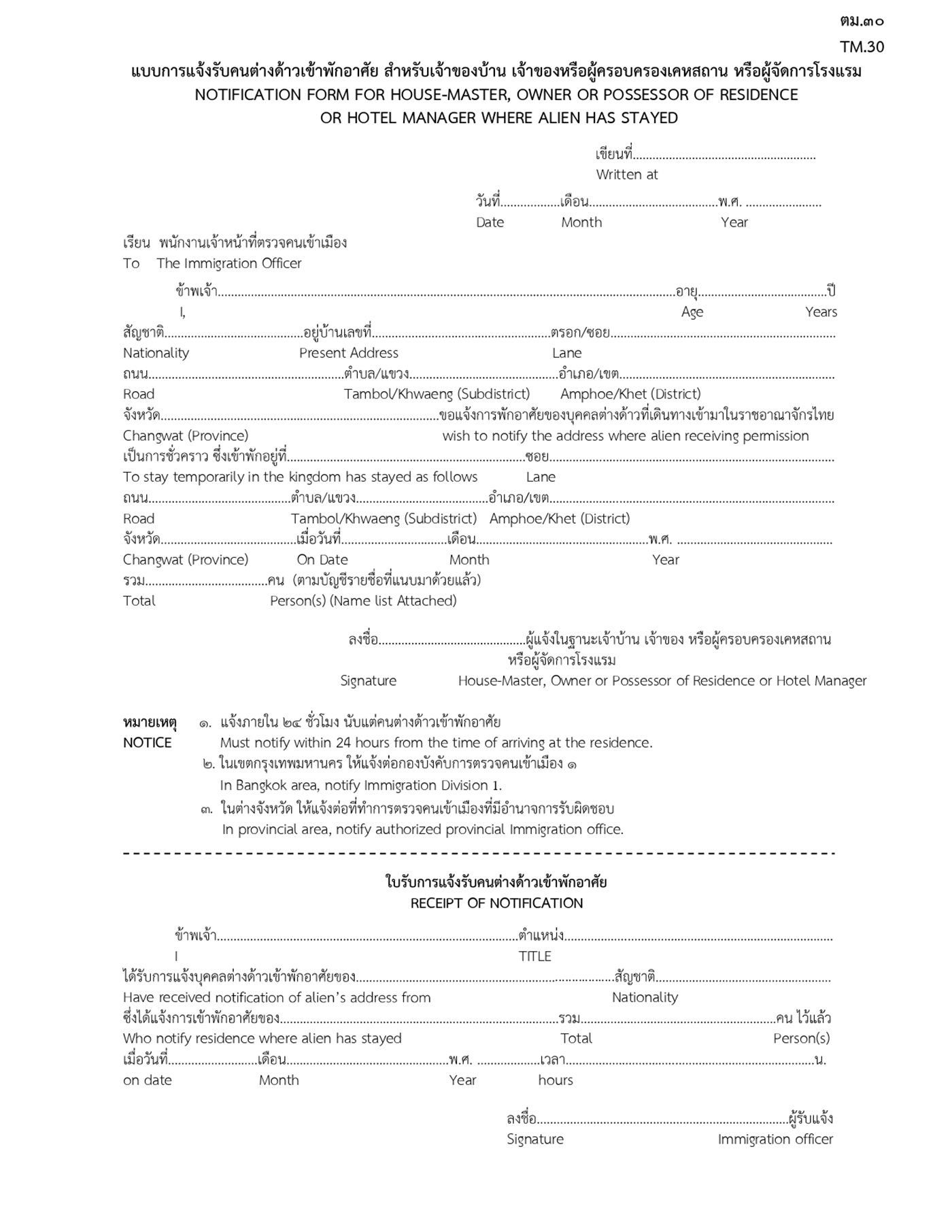

Official TM30 form on page 3 of this document: Immigration Bureau TM30 form.
Step 11 Keep records throughout the tenancy
Good landlord records should make it possible to reconstruct the tenancy without relying on memory.
Keep:
- The signed rental agreement.
- The inventory.
- Photographs from the handover.
- Meter readings.
- Copies of important tenant and property documents.
- Rent payment records.
- Deposit records.
- Repair and maintenance records.
- Receipts and invoices for relevant expenses.
- Messages and notices concerning important tenancy matters.
- TM30 confirmation where applicable.
- Records from the move-out inspection.
Don’t rely entirely on messaging apps – important agreements should be recorded clearly enough that you can find them later.
Step 12 Be clear about who pays for what
A surprising number of tenancy disagreements are really misunderstandings about money.
Decide in advance who pays for:
- Electricity.
- Water.
- Internet.
- Gas or other utilities, if applicable.
- Consumables.
- Condominium fees and common-area charges.
- Parking.
- Routine maintenance.
- Appliance servicing.
- Replacement of worn-out items.
- Damage caused by the tenant or the tenant’s guests.
Put these arrangements in the rental agreement. If a cost is likely to be disputed later, it’s particularly important to establish the rule before the tenancy starts.
If you operate three or more residential rental units as a business and the OCPB controlled-contract rules apply to you, pay particular attention to the rules concerning electricity and water charges.
Step 13 Check your insurance
Don’t assume that an insurance policy you bought while living in the property automatically provides the same cover when the property becomes a rental.
Tell your insurer that the property will be rented out and ask what cover applies to the building, contents, liability, water damage, fire, theft, and other relevant risks.
If the property is a condominium, check how the building’s insurance and your own unit insurance interact.
Step 14 Understand your rental income for tax purposes
Rental income is taxable income in Thailand. For an individual landlord, income from letting property is generally dealt with under Section 40(5) of the Revenue Code.
The Revenue Department’s current guidance provides a useful starting point for an individual renting out a building: you can generally deduct either the 30% standard expense deduction or eligible actual expenses supported by the required documentation.
For example: if you receive THB 300,000 in rent from a building during the year, a 30% standard expense deduction would be THB 90,000. That leaves THB 210,000 as the amount remaining after that particular expense deduction, before the other deductions and allowances that may apply when calculating your taxable income.
The 30% isn’t a 30% tax rate: It’s an expense deduction used in calculating taxable income.
You can also choose actual allowable expenses instead of the standard deduction where the relevant rules permit it, but you need appropriate supporting documents.
See the Revenue Department’s English personal income tax guidance.
See the Revenue Department’s English guide to rental income under Section 40(5).
What about withholding tax?
Withholding tax is a separate issue. It can arise where the person paying the rent is a company or other entity that has a withholding obligation. It doesn’t mean that every residential tenant simply deducts 5% from the rent.
If you rent property to a company, have several properties, operate through a company, or are a non-resident for Thai tax purposes, it’s worth getting professional tax advice rather than relying on the simple 30% example above.
Your tax position can also depend on your overall income, the type of property, how the property is owned, whether you’re resident or non-resident for Thai tax purposes, and whether you use the standard deduction or actual expenses.
For a typical individual landlord with one property: Start by understanding that the rent is taxable income and that the Revenue Department provides a 30% standard expense deduction for rental income from buildings. Then consider your other income, deductions, allowances, and personal circumstances when working out the actual tax payable.
The Revenue Department’s English guidance: Revenue Code — Section 40.
Step 15 Know what happens if the tenant stops paying
Hopefully you will never need this section, but it’s much better to know what you would do before the problem happens.
Start by checking the rental agreement. Confirm the amount due, the payment date, and any notice provisions. Contact the tenant promptly and keep a written record of the communication.
Thai Civil and Commercial Code Section 560 also provides a general rule concerning termination for non-payment of rent. Where rent is payable monthly or at longer intervals, the landlord must first notify the tenant and give at least 15 days to make the payment before terminating on that basis. The agreement and any applicable special rules can also matter.
If the problem continues, follow the agreement and applicable legal procedures. If the amount involved is significant or the tenant disputes the position, get appropriate legal advice.
Don’t try to solve a non-payment problem by taking matters into your own hands. Never change the locks, remove the tenant’s belongings, or cut essential services to force the tenant out. Use the appropriate contractual and legal process.
Step 16 Understand the three-year lease rule
Longer leases need particular care.
Under Section 538 of the Thai Civil and Commercial Code, an immovable-property lease for more than three years, or for the life of the lessor or lessee, is enforceable for more than three years only when there’s written evidence and the lease is registered by the competent official. Without registration, the lease is generally enforceable only for the first three years.
This is particularly important if you’re negotiating a five-year, 10-year, or other long lease and assuming that the signed agreement alone provides the same protection as a registered lease.
See the Thai Civil and Commercial Code — Book 3, Specific Contracts for the general lease provisions, including Section 538.
If you’re considering a lease longer than three years, get professional advice before signing it. The registration process, fees, taxes, and wording of the agreement can matter.
Step 17 Manage the tenancy like a small business
Even if you own only one rental property, it helps to think of it as a small business rather than an informal arrangement.
Keep track of:
- Rent received.
- Repairs and maintenance.
- Insurance.
- Utilities and other property costs.
- Tax-related records.
- Dates for inspections and important tenancy events.
- Deposit received and returned.
- Tenant communications.
- Contract renewal or termination dates.
Put aside money for repairs rather than treating every month’s rent as disposable income. Air-conditioning units fail, washing machines break, plumbing needs attention, and properties need repainting and refreshing over time.
Step 18 Know what happens when the tenancy ends
The end of the tenancy should be handled with the same care as the beginning.
Arrange a move-out inspection and compare the property with the original inventory and photographs. Record meter readings and collect keys, access cards, remotes, and other property items.
Separate ordinary wear and tear from damage caused by the tenant. A property naturally shows some signs of use during a normal tenancy; that’s not necessarily the same thing as damage the tenant should pay for.
If the OCPB controlled-contract rules apply to your rental business, there are specific requirements concerning deposits. The current OCPB guidance states that where no tenant damage is found, the deposit must be returned within seven days after the contract ends.
For landlords outside that regime, there isn’t a universal seven-day deadline like the one imposed by the OCPB rules. The rental agreement, the general law of lease, and any other applicable legislation still matter when determining how the deposit should be dealt with.
Practical landlord checklist
Before advertising
- Check that you can rent out the property.
- Check condominium or development rules.
- Decide between residential and short-term rental.
- Establish whether the three-unit OCPB rules apply.
- Research the market rent.
- Prepare the property.
- Prepare photographs and an inventory.
Before signing
- Check the tenant’s identity and relevant information.
- Agree the rent and payment date.
- Agree the deposit and advance rent.
- Set out utility arrangements.
- Use an appropriate written agreement.
- Check whether stamp duty applies.
- Decide who handles TM30 where relevant.
At handover
- Clean the property.
- Complete the inventory.
- Take photographs.
- Record meter readings.
- Hand over keys and access cards.
- Confirm payments.
- Complete any required TM30 notification.
During the tenancy
- Keep rent records.
- Keep repair records.
- Respond to maintenance issues.
- Keep important communication in writing.
- Keep tax records.
- Keep TM30 confirmation where applicable.
If rent is not paid
- Check the agreement.
- Confirm what is owed.
- Contact the tenant promptly.
- Keep written records.
- Follow the agreement and applicable legal process.
- Get legal advice if necessary.
At move-out
- Inspect the property.
- Compare it with the original condition.
- Record meter readings.
- Collect keys and access devices.
- Separate wear and tear from damage.
- Settle outstanding amounts.
- Deal with the deposit according to the agreement and applicable rules.
Common mistakes new landlords make
- Pricing from emotion. The rent needs to reflect the market, not simply what you would like to earn.
- Advertising before checking the rules. Check the building and rental restrictions first.
- Using an old rental agreement. Rules and circumstances change, so don’t assume an agreement from several years ago is still appropriate.
- Taking too much money upfront. Check the rules that apply to your rental before setting the deposit and advance-rent arrangements.
- Adding unexplained utility charges. State clearly how utilities are calculated and check the OCPB requirements if your business is covered.
- Using poor photographs. Good photographs are one of the easiest ways to present a property properly.
- Failing to document condition. Take photographs and complete an inventory before the tenant moves in.
- Leaving repairs and expenses vague. Decide who pays for what before problems arise.
- Ignoring tax. Keep records from the beginning rather than trying to reconstruct the numbers later.
- Forgetting TM30. Establish who is responsible when the tenant is a foreigner.
- Assuming “30 days” answers every short-term rental question. The actual legal category of the accommodation matters.
- Assuming OCPB rules apply to every landlord. The controlled-contract regime has a specific scope, including the three-unit threshold.
When is professional help worth paying for?
You don’t necessarily need a lawyer, tax adviser, property manager, or agent simply because you own one rental property. But there are situations where professional advice can save considerably more than it costs.
You’re negotiating an unusually long lease, handling a serious dispute, or dealing with a complicated ownership or tenancy arrangement.
You have several properties, substantial rental income, company ownership, non-resident tax issues, or complicated expenses.
You live far away, have limited time, or don’t want to deal personally with tenants, inspections, repairs, and day-to-day management.
You want to operate short-term accommodation or are unsure whether your property falls within hotel or non-hotel accommodation rules.
Want to advertise your property?
If you’re looking for a place to advertise your house, condominium, land, or other property, you can join the Home & Travel Facebook community.
The bottom line
Renting out property in Thailand doesn’t have to be complicated, but it pays to approach it as a business from the beginning.
First establish what kind of rental you’re offering and which rules apply. Then price the property realistically, prepare it properly, choose the tenant carefully, use a clear written agreement, document the handover, keep good records, and understand your responsibilities during and at the end of the tenancy.
If you’re renting out one property as a normal home, you don’t need to treat yourself as though you’re automatically running a three-unit residential rental business. But you should still take the basics seriously: your property rules, rental agreement, tax, insurance, records, and any immigration obligations for foreign tenants.
Once you have those foundations in place, being a landlord becomes much more manageable — and much less likely to produce unpleasant surprises later.
Frequently asked questions
Can I rent out my condominium in Thailand?
Usually, yes, provided your ownership and the condominium’s rules allow the type of rental you’re proposing. Check the condominium’s regulations, especially if you’re considering short stays.
Do I need a written rental agreement?
A written agreement is strongly advisable because it records the rent, deposit, tenancy period, responsibilities, and other important terms. Thai lease law also contains specific requirements concerning written evidence and registration for longer immovable-property leases.
What is the 2025 controlled-contract regime?
It’s an Office of Consumer Protection Board (OCPB) regime governing residential rental businesses that have three or more rental units. Covered businesses must use the applicable standard residential rental contract and comply with requirements concerning matters such as deposits and utility charges.
Does the 2025 OCPB regime apply to someone renting out one condominium?
The OCPB definition of the covered residential rental business is based on having three or more rental units. A private owner renting out one condominium as a home is therefore not automatically brought within this particular three-unit regime.
What rules apply if I am outside the OCPB regime?
Being outside the OCPB controlled-contract regime does not mean that the tenancy is unregulated. The general Thai Civil and Commercial Code provisions on leases still apply, together with the terms of the agreement and other applicable legislation. The Unfair Contract Terms Act can also be relevant to certain contractual terms.
Where can I find the general Thai rules on leases?
The Thai Civil and Commercial Code contains the general provisions on leases, including sections dealing with the definition of a lease, registration of longer leases, subletting, repairs, permitted use, and non-payment of rent. See Book 3, Specific Contracts.
What is the Unfair Contract Terms Act?
The Unfair Contract Terms Act B.E. 2540 (1997) provides a framework for assessing certain contractual terms that give one party an unreasonable advantage. It’s separate from the OCPB controlled-contract regime and forms part of the wider Thai contract-law framework.
Where can I find the OCPB standard rental contracts?
The OCPB has published standard forms for short-term and long-term residential leases under the 2025 regime. See the OCPB’s current page about the standard forms (Thai).
How much deposit can I take?
If your rental business is covered by the OCPB controlled-contract rules, specific limits apply to advance rent and deposits. If you’re outside that regime, a deposit of around one to two months’ rent is a common market standard for an ordinary private residential letting. The agreement should clearly state the amount, what it can be used for, and how and when any balance will be returned.
When does the landlord have to return the deposit?
For a residential rental business covered by the OCPB controlled-contract rules, the current OCPB guidance provides for the deposit to be returned within seven days after the contract ends where there’s no tenant damage requiring deduction. For landlords outside that regime, there isn’t a universal seven-day deadline like the one imposed by the OCPB rules. The return date should be addressed clearly in the rental agreement. A practical timeframe commonly written into agreements is 14 to 30 days after move-out, allowing time for the final inspection and utility reconciliation.
Can I charge my tenant more than the utility company charges me?
If your residential rental business is covered by the OCPB controlled-contract rules, the current rules restrict electricity and water charges and require the calculation method to be clear. A landlord outside that regime should still state utility arrangements clearly in the agreement and comply with any other applicable law.
Do I have to pay stamp duty on a rental agreement?
A rental agreement covering land, a building, another structure, or a floating house can be subject to Thai stamp duty. The duty is separate from income tax.
What is TM30?
TM30 is the immigration notification concerning a foreigner’s residence. The responsibility generally falls on the house-master, owner, possessor of the residence, or hotel manager accommodating the foreigner.
Does a new TM30 have to be filed every time a foreign tenant returns to Thailand?
On a strict reading of the Thai Immigration Act, the TM30 notification obligation is linked to the foreigner’s arrival at the residence, so a fresh notification can be required after the tenant re-enters Thailand even if they return to the same address. In practice, however, local Immigration offices can handle this differently. Some may check the latest entry against the TM30 record, while others may be more relaxed where the tenant has returned to the same residence. To minimise the chance of problems with a later 90-day report, extension, or other immigration service, it’s safest to check the local practice and, where appropriate, arrange a fresh TM30 after re-entry.
Can I file TM30 online?
Yes. The Immigration Bureau operates an online TM30 system. Open the official TM30 system.
Is TM30 the same as 90-day reporting?
No. TM30 concerns notification of a foreigner’s residence and is generally the responsibility of the accommodation provider. 90-day reporting is a separate immigration requirement concerning the foreigner’s own reporting obligation.
How is rental income taxed in Thailand?
Rental income is generally assessable income. For an individual renting out a building, the Revenue Department provides a 30% standard expense deduction, or the taxpayer may be able to use actual allowable expenses with supporting documents. The 30% is a deduction, not a 30% tax rate.
Does every landlord have to deduct 30%?
No. The Revenue Department’s guidance allows the standard deduction as an option for relevant rental income, while actual allowable expenses can be used where the requirements are met and supporting documents are available.
What happens if I lease the property for more than three years?
For an immovable-property lease of more than three years, registration at the Land Office is important if the full agreed period is to have legal effect. Without registration, the lease is generally enforceable only for the first three years.
Can I rent my property to tourists?
Possibly, but don’t assume that an ordinary condominium or house can automatically be used for tourist accommodation. Hotel legislation, the non-hotel accommodation framework, condominium rules, and local requirements can all be relevant. Establish which category applies to your property before offering short stays.
What should I do if my tenant stops paying?
Check the agreement, confirm the amount owed, communicate with the tenant in writing, and follow the applicable contractual and legal process. Section 560 of the Civil and Commercial Code also contains a notice requirement for termination for non-payment where rent is payable monthly or at longer intervals. Never change the locks, remove belongings, or cut essential services.
Do I need a property agent?
No. Many landlords manage a single property themselves. An agent can be useful if you live elsewhere, have limited time, or want someone else to handle advertising, tenant communication, inspections, rent collection, and maintenance.
Should I photograph the property before the tenant moves in?
Yes. Photographs, an inventory, and meter readings provide a useful record of the property’s condition at the start of the tenancy and can make the move-out process much easier.
This guide is intended as practical information rather than individual legal or tax advice. Rules and administrative practices can change, so check the current requirements that apply to your property and circumstances before entering into a tenancy.
Comments