









Wat Saket Ratchaworamahawihan
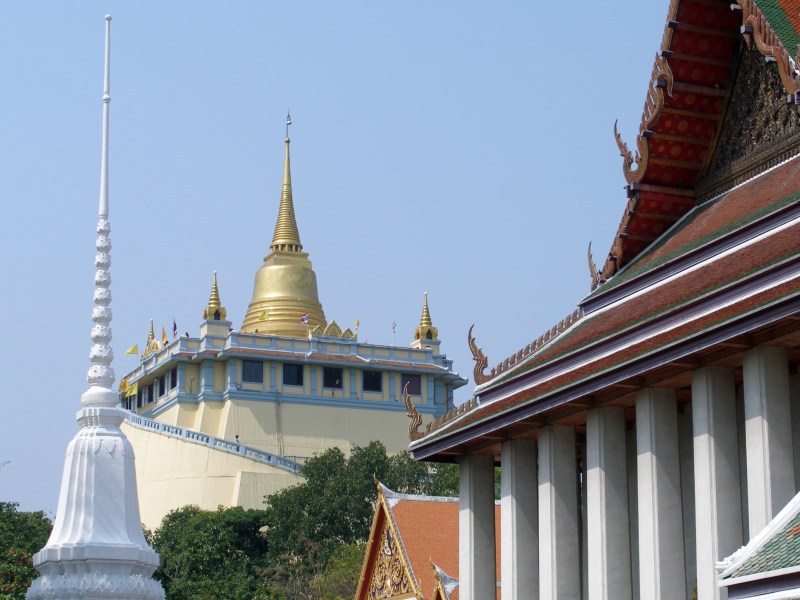
Wat Saket Ratchaworamahawihan is a royal temple in the Pom Prap Sattru Phai area of Rattanakosin. It was formerly Wat Sakae, an Ayutthaya-period temple, and it is classed as a second-class royal temple (Rajavaramahaviharn). Rama I restored the monastery, had a canal dug around it, and gave the name Wat Saket, which translates as washing the hair, after a royal hair-washing ceremony when he returned from Cambodia and took the throne.
People call it Wat Phu Khao Thong. The pagoda Phu Khao Thong, or Borom Banphot, was built in the reign of King Nang Klao (Rama III) to hold Buddha relics excavated from an old pagoda at Kapilavastu. Every year at Loi Krathong there is a seven-day, seven-night celebration to pay respect to those relics.
Rama III ordered a pagoda meant to compare with Wat Phu Khao Thong in Ayutthaya, on a square base with 12 indented corners and sides of 100 meters. The base later dropped by 18 meters and construction stopped. In 1865 Rama IV laid a foundation stone, had the base rebuilt as a hill with a pagoda and a terrace, and named it Borom Banpot. Rama V carried the work through to completion.
When Chakkaphatdiphong Road was extended from Worachak Road, the canal in front of the temple was filled to make the road, and a wall was built on the east side of the compound. Finishing the Golden Mount took three reigns. The temple’s English page also recounts a cholera epidemic in the reign of Rama II and says vultures at the cremations made the place known in a popular phrase as the vultures of Wat Saket. Those pages do not state a street number, opening hours, or an admission fee.
Photo: Wat Saket, Golden Mount, Bangkok, Thailand.jpg by Vyacheslav Argenberg, CC BY 4.0 (2007).